While St Cuthbert’s Way takes you through the high, heather-clad silence of the Cheviots, the Forth to Farne Way offers something altogether more rhythmic.
This is a coastal pilgrimage of salt air, screaming gulls, and the vast, shifting light of the North Sea.
It is a route that mirrors the maritime journeys of the early Celtic saints—men like Baldred, Aidan, and Cuthbert—who viewed the sea not as a barrier, but as a highway for the soul.
For the ChurchMouse reader, the Northumberland stretch of this cross-border route provides a stunning lesson in how the early church clung to the “edge of the world.”
The Spirit of the Shoreline: Northumberland’s Maritime Sanctity
The Northumberland section begins as you cross the border at the historic walled town of Berwick-upon-Tweed.
From here, the path follows the dramatic “low cliffs” and sandy bays south toward the holy silhouette of Lindisfarne.
The Tangible Experience: The Sand and the Sky
The defining experience of this route is the Constant Horizon. Unlike the enclosed valleys of the Holystone Way, the Forth to Farne Way forces the pilgrim to look outward.
- The Sensation: The crunch of marram grass underfoot and the transition from the hard, paved ramparts of Berwick to the soft, shifting dunes of Goswick.
- The Living History: As you walk, the Farne Islands and Holy Island remain in your peripheral vision—a constant “North Star” for your journey.
The Journey: From Berwick to the Sacred Isle
The final leg of this pilgrimage is roughly 15 miles (24km) from Berwick-upon-Tweed to the Lindisfarne Priory.
It is a walk of transitions: from the military might of the border town to the monastic peace of the island.
1. Departure: Berwick’s Holy Corner
Start at the Church of the Holy Trinity in Berwick—one of the few churches built during the Commonwealth period. As you leave the town via the Elizabethan walls, you are tracing a path where monks and soldiers have brushed shoulders for centuries.
2. Spittal and the “Healing” Waters
Walking south through Spittal, you encounter the Victorian heritage of “sea-bathing.” In the early church, these waters were seen as cleansing in a more spiritual sense. It is a place to pause and watch the grey seals—descendants of the creatures that, legend says, warmed St Cuthbert’s feet after his night-time vigils in the waves.
3. The Path to Cuthbert’s Cave
A slight detour inland (but still part of the spiritual trail) leads to St Cuthbert’s Cave (Holburn). It is a massive sandstone overhang where the monks carrying Cuthbert’s body rested.
- Visitor’s Tip: The cave is silent and cool even in high summer. The graffiti carved into the stone spans centuries—a physical record of the thousands of pilgrims who have sought shelter here before you.
4. The Arrival: The Pilgrims’ Way
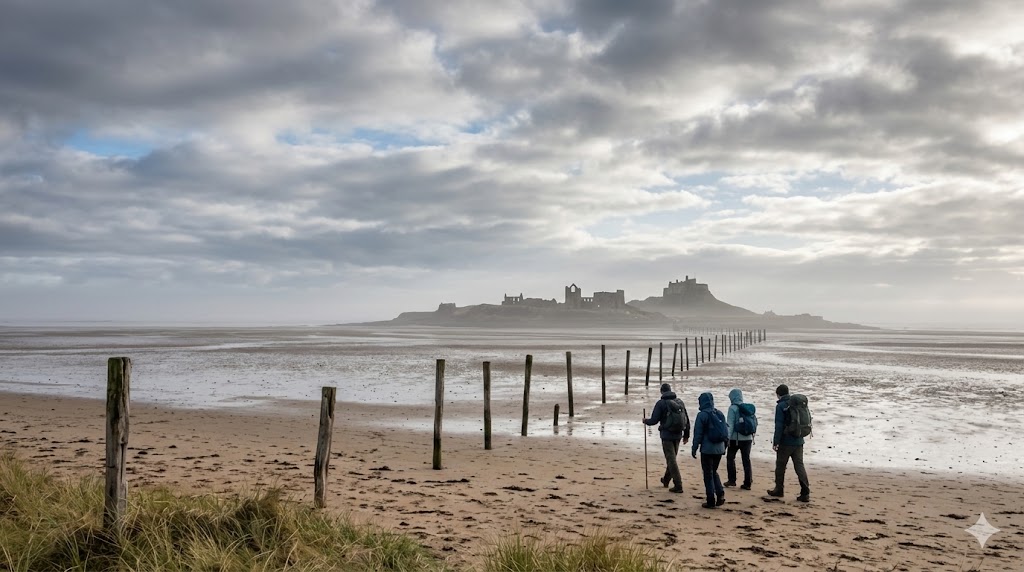
The climax of the journey is the crossing to Holy Island. While many take the road, the true pilgrim waits for the tide to recede to walk the Pilgrims’ Way—a line of wooden poles marking a path across the mudflats.
A Practical Visitor’s Guide
| Feature | Detail |
| Distance | 15 miles (Berwick to Lindisfarne section) |
| Difficulty | Moderate; mostly flat but the dunes can be tiring. |
| The Tide | CRITICAL: Check the Holy Island crossing times. Never attempt the Pilgrims’ Way on a rising tide. |
| Key Landmarks | Berwick Walls, Cocklawburn Beach, St Cuthbert’s Cave, Lindisfarne Priory. |
| Transport | Berwick is on the East Coast Main Line. The 477 bus connects Holy Island to Berwick (check seasonal timetables). |
The Philosophy of the Edge
To walk the Forth to Farne Way is to embrace the “Thin Places”—locations where, in Celtic tradition, the veil between the physical and the spiritual is at its most transparent.
The coastal path is a constant reminder of the impermanence of the world; the tide comes in, the tide goes out, and the ruins of the Priory remain as a testament to a faith that survived Viking fire and North Sea gales.
As you stand on the dunes at Goswick and look across the water to the Priory, you aren’t just looking at a tourist site; you are looking at the cradle of English Christianity.
Leave a Reply