In the modern rush to reach the tidal majesty of Lindisfarne, many pilgrims bypass the quiet, emerald valleys of the Upper Coquet.
Yet, tucked away in the shadows of the Simonside Hills lies a route of profound stillness: The Holystone Way.
While St. Cuthbert and St. Oswald were the warrior-saints and bishops of the North, the Holystone Way belongs to a different tradition—one of deep contemplation, hidden springs, and the enduring presence of the Augustinian nuns who called this valley home for over 400 years.
The Soul of the Journey: Holystone Priory
To understand this route, one must look past the grand stone arches of Hexham or Durham and look instead for what is missing.
Founded in the 12th century, Holystone Priory was a small house of Augustinian nuns.
Unlike the wealthy male monasteries, these women lived a life of rigorous poverty and service in a borderland frequently torn by Reiver raids.
Today, the Priory is gone, its stones recycled into the village cottages. But the “Lady’s Well”—the spiritual heart of the route—remains.
The Tangible Experience: Lady’s Well
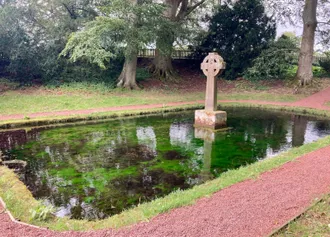
Managed by the National Trust, this is one of the most evocative sacred sites in Britain. A short, grove-lined walk from the village centre leads you to a rectangular stone-lined pool of crystal-clear water, fed by a constant natural spring.
- The Sight: A 14th-century stone statue of a monk (likely moved here from the Priory) gazes over the water.
- The Sound: The rhythmic, gentle bubbling of the spring—a sound that has not changed since St. Paulinus performed mass baptisms here in 627 AD.
- The Ritual: It is traditional to walk the perimeter of the well in silence, reflecting on the “living water” that has drawn people to this specific grove for nearly two millennia.
The Route: From Rothbury to the High Coquet
The “Way” traditionally links the monastic hub of Rothbury to the Priory at Holystone.
It is a journey of roughly 7 miles (11km), making it a perfect single-day pilgrimage that balances physical effort with spiritual reward.
1. Departure: Rothbury and All Saints
Begin at All Saints Parish Church in Rothbury. Look closely at the base of the font; it is carved from the shaft of a 9th-century Anglo-Saxon cross.
It depicts the “Ascension,” a reminder that your physical climb into the hills mirrors a spiritual ascent.
2. The Carriage Woods and The Climbing Path
As you leave Rothbury heading west, the path rises through the Carriage Woods.
The terrain here is “Northumberland Moss”—springy, damp, and smelling of pine and ancient earth.
- Visitor’s Tip: The climb is steady but can be slick. Solid, waterproof boots are non-negotiable here. As you gain height, look back: the view of the Coquet winding like a silver thread toward the sea is your first reward.
3. Caistron and the River Meadows
The path eventually drops down toward the haughs (river flats) of the Coquet near Caistron. Here, the landscape shifts from rugged moorland to lush, bird-rich wetlands.
The nuns would have used these fertile lands for grazing. It is a place of immense horizontal scale—big skies and the constant calling of curlews.
4. Arrival: Holystone Village
Entering Holystone feels like stepping through a fold in time. It is a “closed” village, meaning it has seen very little modern development.
- The Salmon Inn: A quintessential Northumbrian pub. After a day of silence, the crackle of a wood fire and a local ale provide the “communal” end to your solitary trek.
A Practical Visitor’s Guide
| Feature | Detail |
| Distance | Approximately 7 miles (Linear) |
| Difficulty | Moderate; some steep gradients leaving Rothbury. |
| Terrain | Woodland tracks, open moorland, and riverside paths. |
| Best Time | Late Spring (for the wildflowers at Lady’s Well) or Autumn (for the heather). |
| Transport | Bus 470/473 connects Rothbury to Morpeth/Alnwick. Holystone is remote; a pre-booked taxi back to Rothbury is recommended if not walking both ways. |
Connecting the Philosophical to the Practical
To walk the Holystone Way is to practice the Augustinian virtue of Interiority—the idea that the path to God leads inward.
While the great coastal routes offer epic vistas, Holystone offers shelter. It reminds the pilgrim that the “church” is not always a cathedral; sometimes, it is a stone-lined well in a quiet wood and the steady rhythm of one’s own breathing.
As you stand by the Lady’s Well, remember that you are standing where thousands have sought renewal. The water is cold, the air is still, and the history is tangible.
Leave a Reply