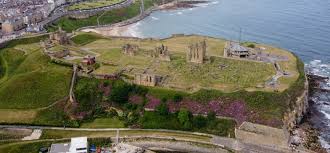
If Lindisfarne is the cradle of Northumbrian Christianity, Tynemouth is its shield.
Perched on a jagged limestone headland, the ruins of the Priory stand as a skeletal silhouette against the North Sea.
This was a “Double Monastery” (housing both monks and a royal garrison), a necessity in a location that was a prime target for every Viking, Scot, and privateer that sailed the coast.
The Soul of the Headland: The Royal Martyrs
Tynemouth’s spiritual weight comes from its status as a royal necropolis.
It is the final resting place of St Oswin, the King of Deira.
Legend says his burial place was forgotten until he appeared in a vision to a monk named Edmund, leading to the re-discovery of his remains and the site’s rise as a major pilgrimage destination.
The Tangible Experience: The Percy Chantry
While the Great Church lies in ruins, open to the salt spray, the Percy Chantry remains a hidden, intact jewel.
- The Sight: A tiny, 15th-century chapel at the very eastern tip of the Priory. The ceiling is a masterpiece of stone boss carvings—look for the “Green Man” and the heraldic symbols of the Percy family.
- The Sensation: Walking from the howling wind of the headland into the sudden, dead-silence of the Chantry is a physical lesson in the monastic concept of “Sanctuary.”
- The Light: If you visit in the late afternoon, the sun hits the stained glass, bathing the stone in a kaleidoscope of deep reds and blues that feels entirely disconnected from the modern world outside the gatehouse.
The Journey: The Headland Walk
A pilgrimage to Tynemouth is less about miles covered and more about the “climb” toward the light.
1. The Ascent from the Haven
Begin at King Edward’s Bay. Walk up the steep path toward the gatehouse. As the ground rises, the modern world of the Tyneside suburbs disappears, replaced by the massive curtain walls of the castle.
2. The Great Gatehouse
You enter through a formidable 14th-century gatehouse. It serves as a reminder that the monks here were never entirely safe. They lived a life of prayer behind some of the most sophisticated defences in Northern England.
3. The Ruins of the Nave
Walk the length of the nave toward the towering East Wall. The lancet windows, though glassless, frame the North Sea.
Philosophical Note: The monks used these windows as a metaphor—the light of God coming from the East to illuminate the darkness of the world. Standing here, you realise that the architecture was designed to make the pilgrim feel both small and significant.
A Practical Visitor’s Guide
| Feature | Detail |
| Location | Tynemouth, Tyne & Wear (managed by English Heritage). |
| Must-See | The Percy Chantry (you may need to ask the staff for the key if it’s locked). |
| The “Oomph” Moment | Standing at the very edge of the cliff behind the Priory, where the land drops away into the North Sea. |
| Transport | Easily accessible via the Tyne & Wear Metro (Tynemouth Station). |
| The “ChurchMouse” Pub | The Gibraltar Rock, sitting just outside the gates, offers a view of the Priory that has inspired painters for centuries. |
The Philosophy of the Sentinel
To visit Tynemouth is to understand that the spiritual life is a struggle.
The monks didn’t choose this spot because it was easy; they chose it because it was a witness.
They were the sentinels of the North, standing at the mouth of the great river, offering prayers for those at sea and those in the city.
Tynemouth reminds us that even when the walls fall and the roof is gone, the “holy ground” remains.
The prayer doesn’t leave the stone; it becomes part of the cliff itself.
Leave a Reply