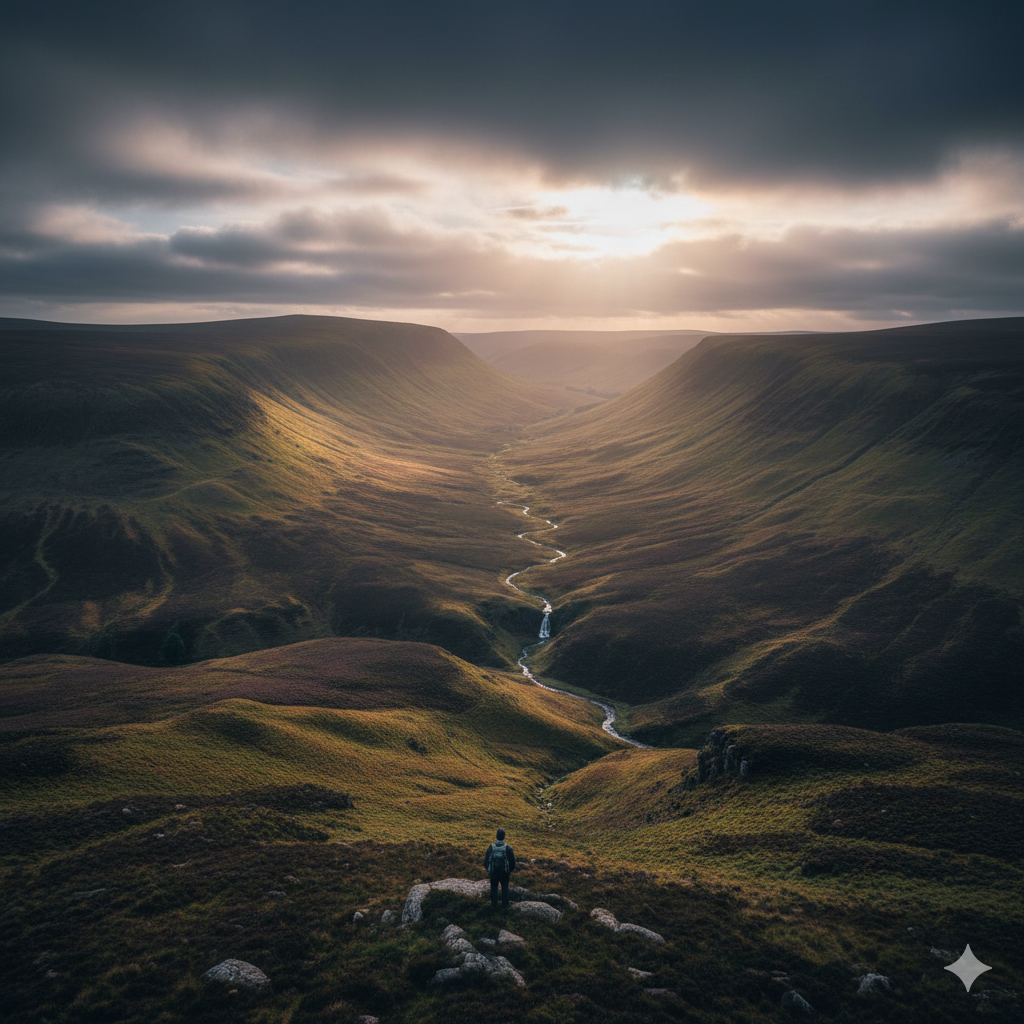
If the Northumberland coast is about the rhythm of the tide, the Cheviot Hills are about the magnitude of the air.
Located in the northern reaches of the Northumberland National Park, these rounded, peat-covered hills represent some of the most remote terrain in England.
This is not a landscape of dramatic jagged peaks, but of vast, sweeping curves and deep, “hidden” valleys. F
or those seeking the ‘Quiet Life,’ the Cheviots offer a specific type of solitude—a high, thin silence that feels entirely detached from the 21st century.
Entering the Harthope Valley
While many walkers head straight for the summit of The Cheviot (the highest point in the county), the true essence of the quiet life is found in the valleys below.
The Harthope Valley, accessed via the small village of Wooler, is a perfect starting point.
As you drive—and eventually walk—deeper into the valley, the modern world falls away.
The road narrows until it becomes a track, and the hum of traffic is replaced by the bubbling of the Harthope Burn and the distant bleating of sheep.
There is no “destination” here other than the landscape itself.
What to Expect in the High Hills:
- The Scale of Solitude: It is entirely possible to hike for four hours here and not see another person. This isn’t just “quiet”—it is profound isolation.
- The Soundscape: Without the dampening effect of trees or the noise of the sea, the soundscape is dominated by the wind and the call of the red grouse. It is a place that forces you to listen.
- The “Big Sky” Effect: On a clear day, the views stretch across to the Scottish Borders. At night, this area becomes part of the International Dark Sky Park, offering a view of the Milky Way that is rarely seen elsewhere in England.
Linhope Spout: A Hidden Sanctuary
For those who want a focused destination without a strenuous mountain climb, the walk to Linhope Spout is essential.
This 60ft (18m) waterfall drops into a deep, circular plunge pool, tucked away in a fold of the hills.
The walk from the tiny hamlet of Linhope is gentle, passing through ancient stands of trees and open moorland.
It is a natural sanctuary—a place to sit on a basalt rock, feel the spray of the water, and simply be. In the summer, the pool is a favourite for wild swimmers, but even then, it retains an air of secret, tucked-away peace.
Practicalities for the High Silence
The Cheviots are beautiful, but they are also wild. To maintain your peace of mind, you need to be prepared:
| Requirement | Why it matters |
| Navigation | Phone signal is non-existent in the deep valleys. Carry a physical OS Map (Landranger 16 or Explorer OL16) and a compass. |
| Supplies | There are no shops, cafes, or pubs once you leave Wooler or Ingram. Pack enough water and food for the entire day. |
| Weather | The weather changes rapidly at 2,000ft. Even if it’s warm in the valley, a “Cheviot Mist” can roll in and drop visibility to zero. |
| Footwear | The “High Hills” are notoriously boggy. Waterproof boots are a necessity, not an option. |
Where to Anchor Your Stay
To truly experience the Cheviots, you should stay as close to the “edge” as possible.
- Wooler: Known as the “Gateway to the Cheviots,” this is a proper Northumberland market town. It has excellent independent butchers and bakers for packing your rucksack, and several quiet, traditional inns.
- Ingram Valley: A little further south, the Breamish Valley and the village of Ingram offer a series of remote holiday cottages and high-end bunkhouses that cater to those who want to step straight onto the hillside from their front door.
- Off-Grid Huts: Look for converted farm buildings or huts in the College Valley—one of the most remote and protected valleys in the park, where car access is strictly limited to those staying there.
The Value of Disconnection
In the Cheviots, the “Quiet Life” isn’t a metaphor; it’s a physical reality.
There are no notifications, no deadlines, and no noise. It is a landscape that demands your full attention and, in return, offers a rare sense of perspective.
Whether you are sitting by the Harthope Burn or looking out from the summit of Hedgehope Hill, you are reminded that silence isn’t the absence of something—it’s the presence of everything.
Leave a Reply