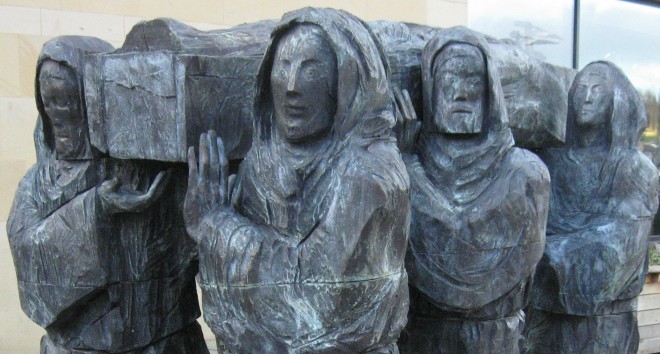
Most pilgrimages are defined by the destination. However, the most extraordinary journey in Northumbrian history is defined by the flight.
In 875 AD, as Viking longships loomed off the coast of Lindisfarne, the monks did the unthinkable: they dug up the body of their beloved St Cuthbert and fled.
For seven years, they wandered the wild North, carrying a wooden coffin and the legendary Lindisfarne Gospels.
To walk this “route” today—a thread of ancient churches across the heart of Northumberland—is to explore the resilience of faith under fire. It is a story of a church that refused to die, even when its home was ashes.
The Spirit of the Wandering: Faith on the Move
This is not a single, linear marked path like the St Cuthbert’s Way. Instead, it is a constellation of sites that offered sanctuary to the monks and their holy “cargo.”
For the ChurchMouse reader, this journey is about Resilience.
The Tangible Experience: The “Cuthbert” Churches
Throughout Northumberland, you will find churches dedicated to St Cuthbert in the most unexpected places. Tradition holds that many of these were sites where the monks rested the coffin.
- The Sight: Low-ceilinged, thick-walled Saxon stone. These buildings feel less like cathedrals and more like fortresses.
- The Sensation: A profound sense of “Sanctuary.” Standing in these spaces, you can almost hear the wind on the moors and the distant threat of the Norsemen.
The Key Sites of the Flight
While the monks covered hundreds of miles into Cumbria and Scotland, the Northumberland heart of the journey contains the most poignant landmarks.
1. Norham: The Great Border Sanctuary
Located on a sharp bend of the River Tweed, St Cuthbert’s Church at Norham was a vital refuge. It is said the saint’s body rested here for a significant time.
- The Experience: The church sits in the shadow of the massive Norham Castle. It represents the “Frontier Church”—sturdy, defiant, and ancient. Look for the fragments of Anglo-Saxon crosses inside, physical remnants of the world the monks were trying to save.
2. Tilmouth: Where the Coffin Floated?
A few miles from Norham lies Tilmouth, where legend takes a supernatural turn. Local folklore claims the stone coffin of St Cuthbert floated down the Tweed to this spot.
- The Experience: It is a place of deep river-silence. Walking the banks of the Till where it meets the Tweed allows for a moment of reflection on the “miraculous” stories that kept the monks’ spirits high during their exile.
3. Elsdon: The Remote Refuge
Deep in the heart of the Redesdale valley lies St Cuthbert’s, Elsdon. This is one of the most complete medieval villages in the county.
- The Experience: The church here is built on a massive scale for such a small village, signifying its importance as a “safe house” for the saint. The silence here is heavy and ancient.
- Visitor’s Tip: Explore the “Mote Hill” nearby—an ancient fortification that reminds you why this remote spot was chosen for safety.
4. Wardley and the Journey South
The monks eventually moved south toward Chester-le-Street and finally Durham.
The journey taught the Northumbrian church that their faith wasn’t tied to a building on Lindisfarne, but lived in the community that protected it.
A Practical Visitor’s Guide
| Feature | Detail |
| Type | A “Pilgrim Circuit” rather than a linear trail. |
| Key Stops | Norham, Tilmouth, Elsdon, Haydon Bridge. |
| Best Way to Travel | A mix of driving and short “loop” walks around each village. |
| Practical Advice | These sites are remote. Ensure your fuel tank is full and check opening times for the smaller parish churches, which often rely on local keyholders. |
| Hidden Gem | The “Cuthbert” stones at Norham—don’t miss the small museum display inside the church. |
The Philosophy of the Fugitive
To follow the Posthumous Journey is to understand that the Church is a moving vessel.
The monks of Lindisfarne were refugees, yet they carried the light of Northumbrian civilization in a wooden box. It teaches us that even when we are uprooted, we carry our “holy things” with us.
Standing in the quiet nave at Elsdon, one realizes that the North was converted not just by sermons, but by the sheer, stubborn persistence of those who refused to let their heritage be forgotten.
Leave a Reply