Deep in the southwest corner of Scotland, where the Machars peninsula reaches into the Irish Sea, lies a place of profound stillness.
Long before Iona or St Andrews became the spiritual centres of the north, there was Whithorn. Walking the Whithorn Way is not merely a hike through the rolling hills of Dumfries and Galloway; it is a journey to the very “Cradle of Scottish Christianity.”
Whether you are seeking a physical challenge, a historical deep-dive, or a quiet space to reset your soul, the Whithorn Way offers a transformative experience unlike any other in Britain.
The History: In the Footsteps of Ninian
The Whithorn Way follows a 149-mile (240 km) route from Glasgow Cathedral to the Whithorn Priory.
Its history is anchored by St Ninian, who in 397 AD established Candida Casa (the White House), the first Christian church recorded in Scotland.
For over a millennium, Whithorn was a site of international pilgrimage. Scottish monarchs, including Robert the Bruce and James IV, made the journey annually, often walking barefoot as an act of penance.
After the Reformation in 1560, the pilgrimage was banned, and the path fell into silence.
It wasn’t until modern times that the route was painstakingly mapped and revived, allowing a new generation of “modern pilgrims” to touch the ancient stones of the Machars once more.
The Personal Harvest: Why Walk the Way?
In our hyper-connected world, the Whithorn Way offers a rare commodity: uninterrupted time.
- A Psychological Reset: The rhythm of walking 15 miles a day acts as a natural “defrag” for the brain. The slow transition from the urban sprawl of Glasgow to the silent, salt-sprayed cliffs of the Solway Firth mirrors an internal shift from chaos to clarity.
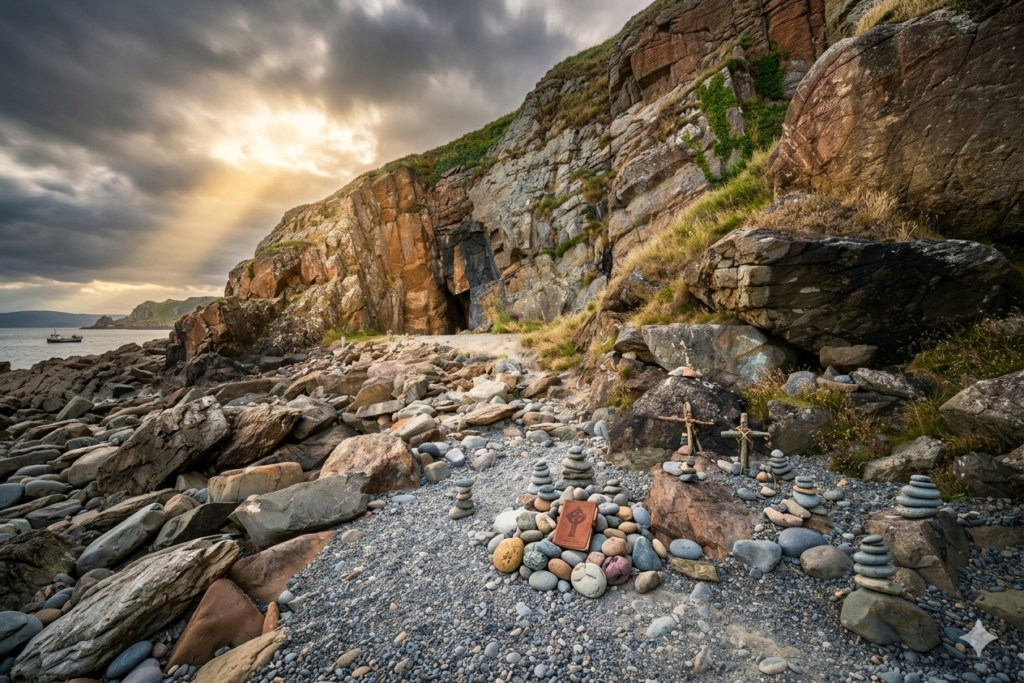
- The Power of “Thin Places”: The Machars peninsula is dotted with “thin places”—locations where the veil between the physical and spiritual worlds feels remarkably sheer. Standing inside St Ninian’s Cave, with the sound of the pebbles shifting in the tide, provides a sense of perspective that no city office can offer.
- Physical Resilience: Completing 149 miles builds a quiet confidence. You learn to trust your body, your boots, and your ability to keep moving forward, one step at a time.
Mapping the Journey: Routes and Timescales
The full Whithorn Way is typically broken into 12 to 14 stages. While the early stages pass through the industrial heritage of the Clyde Valley and the hills of Ayrshire, the “heart” of the pilgrimage lies in the Dumfries and Galloway section.
| Stage | From | To | Distance | Highlights |
| Day 1-4 | Glasgow | Ayr | ~45 Miles | Leaving the city, following the coast. |
| Day 8 | Barrhill | Newton Stewart | 18 Miles | Entering the dark skies and wild forests of Galloway. |
| Day 11 | Newton Stewart | Wigtown | 11 Miles | Scotland’s “Book Town” and the start of the Machars. |
| Day 12 | Wigtown | Whithorn | 12 Miles | Reaching the ancient Priory and the Latinus Stone. |
| Day 13 | Whithorn | Isle of Whithorn | 4 Miles | The final coastal walk to St Ninian’s Chapel. |
Top Tip: If you don’t have two weeks, the “Galloway Section” from Newton Stewart to the Isle of Whithorn (3 days) provides the most historically dense and scenic experience.
Finding Sanctuary: Where to Stay
Accommodation in this rural region requires forward planning.
- Inns and B&Bs: Market towns like Newton Stewart and Wigtown have excellent traditional inns. Look for “Pilgrim Friendly” stickers in windows.
- The Whithorn Trust: They provide invaluable resources for walkers and can often point you toward local homeowners who offer rooms to pilgrims.
- Bothies and Bunkhouses: While rarer than in the Highlands, there are simple bunkhouse options in the Machars for those on a budget.
The Pilgrim’s How-To: Gear and Preparation
Walking in Southwest Scotland means preparing for “four seasons in one hour.”
1. Footwear: You need waterproof, well-worn hiking boots. The terrain varies from tarmac paths to muddy farm tracks and rocky coastal trails.
2. The “Pilgrim Passport”: Purchase a Whithorn Way Passport before you start. You can collect stamps at churches, shops, and cafes along the route, which serves as a wonderful memento and proof of your journey.
3. Navigation: While the route is partially waymarked with the blue pilgrim symbol, the OS Landranger maps (82, 83, and 76) or a dedicated GPS route are essential.
4. Waterproofs: A high-quality Gore-Tex jacket is your best friend. The Solway winds can be fierce.
5. Small Offerings: It is a tradition at St Ninian’s Cave to leave a small stone cross or a pebble as a sign of your visit. Carry a small “pebble of intent” from the start of your walk to leave at the cave.
The Road to the White House
The Whithorn Way is not just a walk; it is an invitation to enter a deeper story.
It is a path that has been smoothed by the feet of kings, saints, and outcasts for over 1,600 years.
As you stand at the tip of the Isle of Whithorn, looking out toward the Isle of Man with the wind in your face, the modern world feels very far away, and the essentials of life—breath, movement, and faith—feel very close.
The cradle is waiting. The path is open.

Leave a Reply