While other Northumbrian saints sought God in the simplicity of a cave or the solitude of the moors, St Wilfrid was different.
He was a man of the world, an innovator, and a builder of stone. To walk St Wilfrid’s Way is to journey through the “Golden Age” of Northumbria—a time when the wild north was being transformed into a sophisticated centre of European culture and Roman order.
For the ChurchMouse reader, this route is about Vision and Structure.
It begins at the monumental Hexham Abbey, a site that served as a physical manifesto for Wilfrid’s belief that the beauty of the earth should reflect the beauty of heaven.
The Soul of the Stone: Hexham’s Roman Heart
The journey starts not in a field, but underground. Before you leave Hexham, you must descend into the Saxon Crypt.
The Tangible Experience: The Roman Spoils
As you stand in the narrow, torch-lit passages of the crypt, reach out and touch the walls.
- The Sight: You will see Roman inscriptions, some upside down. These stones were hauled here from the nearby ruins of Corbridge (Coria).
- The Sensation: The air is cool, damp, and still. There is a profound sense of “repurposed history”—Wilfrid literally built the foundations of his church from the bones of the Roman Empire.
- The Reality: This isn’t just a museum; it is a 1,300-year-old active space of prayer. It is perhaps the most “tangible” link to the 7th century in all of England.
The Route: From the Abbey to the White Village
The Northumberland section of this trail leads you from the bustling market square of Hexham toward the breathtaking seclusion of Blanchland.
1. Departure: The Night Stairs
Begin by climbing (and then descending) the Night Stairs in the Abbey. These are the original stone steps used by the canons to move from their dormitory to the choir for the night offices. It is a powerful “oomph” moment—your boots hitting the same worn stone as the medieval monks.
2. The Devil’s Water and the High Woods
The path winds south through the valley of the Devil’s Water. Don’t be fooled by the name; it is a place of serene beauty.
- The Experience: The terrain here is “High Forest”—lofty pines and deep ravines. It reflects Wilfrid’s own complex life: a mix of deep shadows and sudden, soaring light.
- Visitor’s Tip: Look for the ruins of Dilston Castle nearby. It adds a layer of Jacobite history to your monastic trek, showing how this landscape has always been a place of high stakes and deep convictions.
3. Arrival: Blanchland (The Monastery in the Glen)
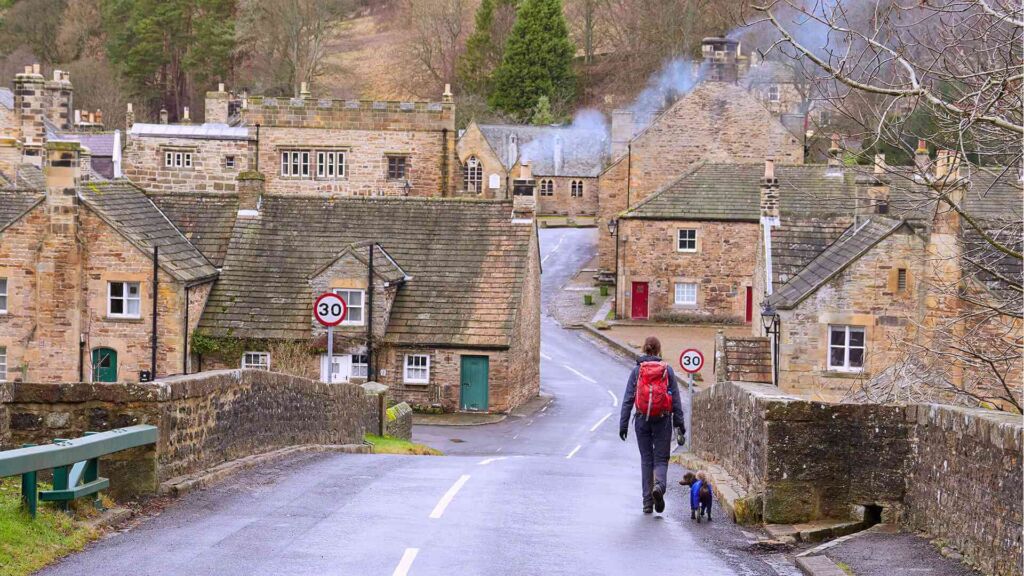
The walk concludes at Blanchland, a village that is essentially a ghost of a Premonstratensian Abbey.
- The Gateway: You enter the village through a medieval gatehouse. The houses are built into the ruins of the abbey cloisters.
- The Experience: This is arguably the most beautiful village in the North. It feels entirely enclosed, a “Sanctuary” in the truest sense of the word.
A Practical Visitor’s Guide
| Feature | Detail |
| Distance | 10 miles (Hexham to Blanchland). |
| Architectural Highlight | The Saxon Crypt and the Frith Stool (the 7th-century throne of sanctuary) in Hexham Abbey. |
| The Terrain | Well-marked forest tracks and riverside paths; less boggy than the “Way of the Spirit.” |
| Where to Refuel | The Lord Crewe Arms in Blanchland. You can eat and drink in the former Abbot’s lodge, complete with a massive medieval fireplace. |
| Best Time | Autumn, when the leaves in the Hexhamshire woods turn a brilliant Wilfrid-esque gold. |
The Philosophy of the Builder
To walk St Wilfrid’s Way is to appreciate the “Ordered Faith.” Wilfrid believed that the Church should be a beacon of civilization—sturdy, beautiful, and enduring.
While Cuthbert found God in the bird and the wave, Wilfrid found Him in the arch and the ashlar.
Standing in the quiet square of Blanchland at the end of your journey, you realize that Wilfrid’s vision worked.
The stones he set in place over a thousand years ago still provide shelter, community, and a sense of belonging today.
Leave a Reply