While St Cuthbert’s Way is the journey of the humble monk, St Oswald’s Way is the epic of the warrior-king.
This 97-mile (156km) pilgrimage links the most iconic holy and royal sites of ancient Northumbria.
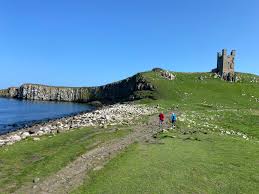
It is a route of dramatic contrasts, beginning on the tidal sands of Holy Island and ending on a high, wind-swept ridge overlooking Hadrian’s Wall.+1
For the modern pilgrim, this path offers a profound exploration of power, sacrifice, and the birth of a nation.
History & Purpose: The Return of the Cross
St Oswald was the 7th-century King of Northumbria who, after years in exile, returned to reclaim his kingdom and establish Christianity as its spiritual foundation.
- The Royal Connection: The route begins at Lindisfarne (the spiritual heart) and passes Bamburgh Castle (Oswald’s royal capital), creating a physical link between church and state.
- The Culmination: The journey ends at Heavenfield, the site of Oswald’s decisive battle in AD 634. Legend says he raised a wooden cross before the fight, praying for a victory that would “restore the faith.”+1
To walk this Way is to trace the trajectory of a man who moved from the edge of the world (exile/Holy Island) to the centre of power (Bamburgh) and finally to a place of ultimate spiritual surrender (Heavenfield).
The Oswald Passport & Stamping Stations
Much like the St Cuthbert’s Way, this route features a Pilgrim Passport to track your progress and earn a completion certificate.
- Where to get it: Passports are available at the Lindisfarne Post Office or can be ordered in advance through the St Oswald’s Way official website.
- Key Stamping Stations:
- St Mary’s, Holy Island: Your departure stamp.
- St Aidan’s, Bamburgh: Located beneath the castle; a site of immense royal and religious significance.
- The Jolly Fisherman, Craster: A popular stop to refuel and stamp.
- St Lawrence’s, Warkworth: A beautiful Norman church near the castle.
- Brinkburn Priory: A secluded 12th-century Augustinian priory.
- All Saints, Rothbury: The hub of the Coquet Valley.
- St Oswald’s, Heavenfield: Your final stamp at the “Gate of Heaven.”
Sanctuary Stays and “Champing” on the Way
Because St Oswald’s Way passes through several “honeypot” coastal villages, traditional hotels can be expensive. For an authentic experience, look for these sacred options:
- Sanctuary Network: The British Pilgrimage Trust lists several churches along the route that offer simple floor space or vestry beds for pilgrims. Key locations include Lowick (near the start) and Heavenfield/Hexham (at the finish).
- Seahouses Hostel: A dedicated, low-cost hub for walkers located right on the coast.
- Bunkhouses & Camping: * Bluebell Farm (Belford): An ideal first-night stop after leaving the island.
- Greencarts Bunkhouse: Located right next to Hadrian’s Wall, perfect for your final night before reaching the end.
- Champing: Historic churches in the Northumbrian hinterland—particularly near the River Coquet—periodically offer Champing stays during the summer months. These must be booked via the Churches Conservation Trust.
The Journey: Key Details
- Distance: 97 miles (156 km).
- Expected Time: 6 to 10 days. An 8-day itinerary is the most popular “balanced” choice.
- Terrain: * The Coast: Flat, sandy, and spectacular (Lindisfarne to Warkworth).
- The River: Gentle, wooded riverside paths (Warkworth to Rothbury).
- The Uplands: Strenuous moorland and forest tracks (Rothbury to Heavenfield).
Preparation & Safety
- The Tide: Like St Cuthbert’s Way, your start is dictated by the Holy Island Crossing Times. You are walking away from the island, but the causeway still governs your departure.
- Navigation: OS Explorer 332, 340, and 342. The coastal section is part of the Northumberland Coast Path and is very well-marked, but the inland sections require more careful navigation.
- Gear: Windproof layers are vital. Even on a sunny day, the coastal “haars” (sea mists) can drop the temperature rapidly.
Accommodation Hubs & Services
- Holy Island: The Open Gate or Marygate House (Retreats).
- Bamburgh: The Lord Crewe or Sunningdale Hotel.
- Craster: The Jolly Fisherman (famous for kippers).
- Rothbury: The Newcastle House or Rothbury YHA.
- Hexham (Terminus): The Beaumont or Battlesteads (a short taxi from Heavenfield).
The “Heavenfield” Experience
Standing at Heavenfield, looking down toward Hexham Abbey, pilgrims often feel a profound sense of reaching the summit.
You have walked from the sea to the sky, mirroring the journey of a king who sought to ground his power in something eternal.
While the path behind you is measured in miles of coastline and riverbank, the true distance covered is internal.
To walk St Oswald’s Way is to witness the enduring soul of Northumberland.
As you leave your final stamp at the “Gate of Heaven” and look back across the rolling hills toward the distant, unseen coast, you carry with you more than just a completed passport.
You carry the resilience of the Northumbrian landscape and the quiet, steady strength of a journey well-travelled.
Leave a Reply