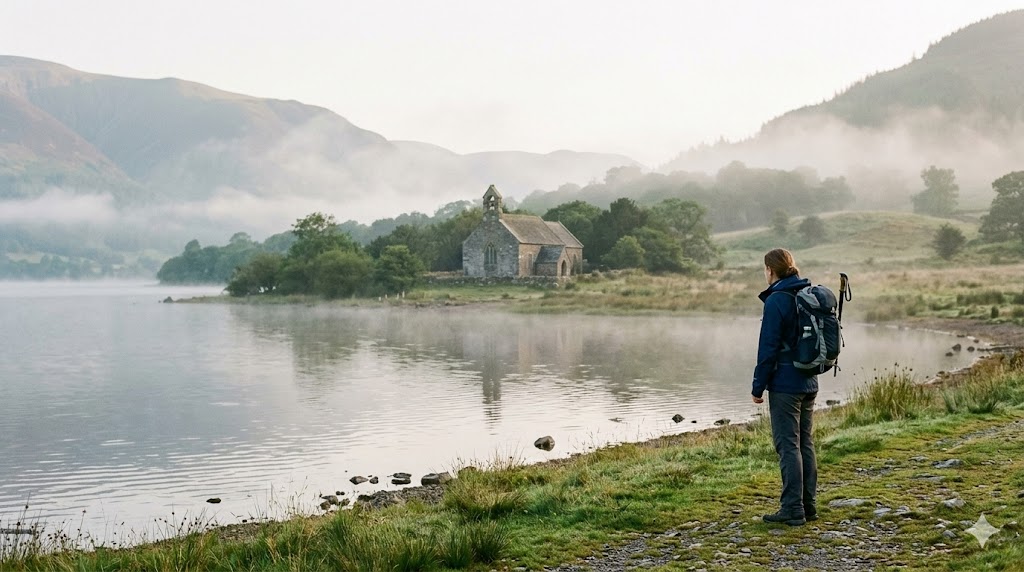
The legend of St. Bega is as atmospheric as the Cumbrian weather. An Irish princess fleeing an unwanted marriage to a Viking prince, she is said to have crossed the sea in a small boat, landing at St. Bees with nothing but a miraculous golden bracelet.
This route follows her purported journey from the rugged coast inland to the sanctuary of Bassenthwaite.
1. The Anchor: St. Bees Priory
The journey begins at St. Bees Priory, a magnificent red sandstone building that feels more like a small cathedral than a village church.
- The History: The current building is Norman (c. 1120), but it sits on a much older religious site. In the 1980s, archaeologists discovered “St. Bees Man”—a perfectly preserved medieval knight wrapped in lead.
- The Relic: Historically, pilgrims came here to swear oaths on “St. Bega’s Bracelet.” Though the bracelet is lost, the sense of sacred justice remains in the heavy, quiet air of the nave.
- Where to Stay: St. Bees has several traditional inns, but for a spiritual start, check if the Priory has local “sanctuary” recommendations for pilgrims.
2. The Ascent: Dent Hill and the Ennerdale Valley
Leaving the coast, the path climbs Dent Hill. This is your “look back” moment—from the summit, you can see the Isle of Man and the Irish coast from which Bega fled.
- The Experience: You descend into Ennerdale, the Lake District’s most remote and “re-wilded” valley. There are no public roads into the upper valley, meaning the silence here is absolute.
- Spiritual Stop: The Church of St. Mary, Ennerdale Bridge. It is a simple, humble place, perfect for a mid-journey prayer.
- Where to Stay: * The Fox & Goose (Ennerdale Bridge): A classic hiker’s rest.
- YHA Black Sail: Further up the valley, this is one of the most famous hostels in the UK. A former shepherd’s bothy with no mobile signal—true monastic isolation.
3. The High Pass: Honister to Borrowdale
Day two (or three) takes you over the Honister Pass. You move from the wildness of Ennerdale into the lush, green “Shire-like” beauty of Borrowdale.
- Tangible Detail: As you descend toward Rosthwaite, look for the ancient stone walls. Many of these follow the original boundaries set by the monks of Furness Abbey, who owned much of this land for sheep farming.
- Where to Stay: Rosthwaite is a cluster of 17th-century stone houses. The Royal Oak has a long history of hosting weary travelers and offers that essential Cumbrian hearth-side welcome.
4. The Sanctuary: Bassenthwaite Lake
The final leg skirts the western shore of Derwentwater before reaching the ultimate goal: St. Bega’s Church, Bassenthwaite.
- The Experience: This 12th-century church is famously isolated, standing alone in the fields of the Mirehouse Estate. There is no village around it; it sits in a grove of trees right on the edge of the lake.
- The Literature: This spot inspired Lord Tennyson’s Morte d’Arthur. It is a place of profound stillness.
- Practical Detail: You reach the church via the grounds of Mirehouse. Ensure you check the “Miles Without Stiles” path if you require an accessible route for this final mile.
Pilgrim’s Practical Guide: St. Bega’s Way
| Stage | Distance | Key Landmark | Vibe |
| St. Bees to Ennerdale | 10 Miles | Dent Hill Summit | Coastal departure |
| Ennerdale to Rosthwaite | 14 Miles | Black Sail Hut | High Mountain Solitude |
| Rosthwaite to Bassenthwaite | 12 Miles | St. Bega’s Church | Lakeside Sanctuary |
Where to Book Your Retreat:
- Hyning Monastery (Near Carnforth): While slightly south of the route, this is the premier Cumbrian spot for a silent, residential monastic stay before or after your walk.
- Rydal Hall (Ambleside): An ideal “basecamp” for Cumbrian pilgrimages, offering a dedicated retreat house and formal gardens.
- The Poieama Community (Loweswater): A small, contemplative community near the route that often welcomes those seeking a more personal spiritual connection.
Conclusion: Finding the Bracelet
We may never find St. Bega’s golden bracelet, but the “ring” of the journey remains.
To walk this path is to understand the Cumbrian landscape not as a playground for tourists, but as a refuge for the soul.
Whether you are fleeing the “Vikings” of modern stress or searching for a forgotten peace, St. Bega’s Way offers a sanctuary that has been waiting for you for over a thousand years.
Leave a Reply