Northumberland is a county defined by a restless past—of Roman legions, border reivers (robbers), and defiant castles. In fact it was once one of the most violent and feudal places on the planet.
However, beneath that martial drumbeat lies a quieter, more profound history: that of its monastic foundations.
These are places where, for centuries, the primary goal was to be still.
For the modern seeker of calm, these abbeys and priories aren’t just historical attractions; they are “machines for contemplation.” They offer a unique pathway to the ‘Quiet Life,’ inviting you to slow down and listen to the weight of the stones.
Hexham Abbey: A Living Legacy of Stillness
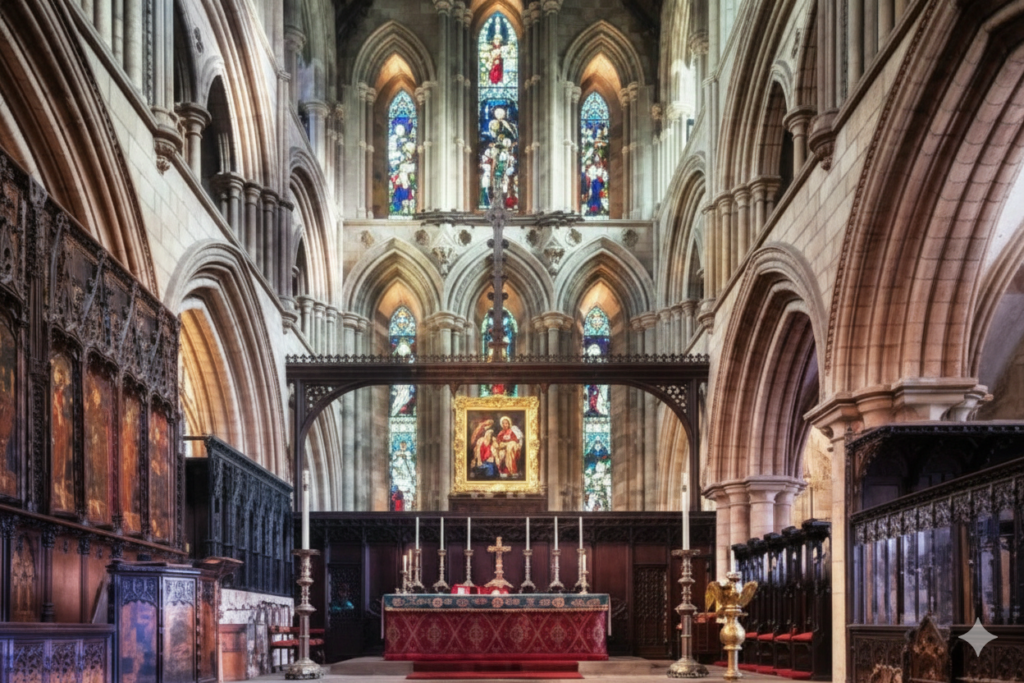
Nestled in the heart of a busy market town, Hexham Abbey is a masterclass in “contained quiet.”
You can walk from the clatter of the Tuesday market through the Great West Door and feel the atmospheric pressure change instantly.
Founded in 674 AD, it boasts an unbroken tradition of worship spanning over 13 centuries.
The Descent into the Earth
The true heart of the Abbey’s “Quiet Life” is found below ground. Descend into the Saxon Crypt, built from stones plundered from the nearby Roman fort of Corbridge.
- The Weight of Years: In this cool, still space—the oldest surviving Anglo-Saxon church structure in England—the air carries the weight of two millennia. It’s a room that forces a perspective that makes your modern to-do list feel mercifully insignificant.
- The Frith Stool: Back in the Nave, you’ll find the ancient Frith Stool. It was a seat of “peace” or sanctuary; if a fugitive reached it, they were safe. Today, it serves as a symbolic reminder that we all need a place where the world can’t reach us.
- Connection to Continuity: Sitting in a quiet pew under the soaring arches of the Nave, you feel a sense of permanence. The soft light filtering through the “Te Deum” window encourages a slower pace, moving from detail to detail until the mind finally quietens.
Brinkburn Priory: The Secluded Riverside Haven
For those seeking truly profound isolation, Brinkburn Priory is an unparalleled choice.
Tucked into a sharp, wooded loop of the River Coquet, it remains Northumberland’s best-kept monastic secret.
It is a place that demands a conscious journey, rewarding the slow traveller with a silence that is almost tangible.
A World Away from the Modern
The journey to Brinkburn is part of the therapy. A winding, single-track road leads you deep into the valley, past fields and ancient trees, building a sense of anticipation that you are leaving the 21st century behind.
- The Acoustic Sanctuary: Because the priory is nestled in a deep valley, the geography does the heavy lifting for you. The high banks of the Coquet act as natural soundproofing. Inside the 12th-century church, the “living silence” is famous; even a whispered word carries, yet the air feels thick and protective.
- Nature’s Embrace: Step outside the stone walls and stroll down to the riverbank. The gentle murmur of the water and the rustle of leaves create a natural symphony. It’s a perfect spot for “forest bathing”—simply recharging amidst trees that have stood as long as the ruins.
Lindisfarne Priory: Where Faith Met the Sea
On Holy Island, the “silent experience” is dictated by the moon and the sea.
Accessible only at low tide, this island retreat was once the heart of Anglo-Saxon Christianity.
The Tidal Clock
The unique tidal causeway immediately sets Lindisfarne apart. When the North Sea rises and covers the road, the day-trippers vanish, and a profound sense of isolation descends.
- The Monastic Ruins: Walk among the red sandstone arches, open to the sky. Imagine the lives of the monks who lived here, enduring the wild elements for the sake of scholarship and faith. The “forced slowness” of waiting for the tide to turn is a rare, restorative surrender of control.
- St. Cuthbert’s Isle: At low tide, a short walk to this tiny islet—marked by a simple wooden cross—provides an uninterrupted view of the sea. It is a place of raw, unadulterated peace.
Navigation the Sacred: A Visitor’s Guide to the Quiet
To experience these sites as sanctuaries rather than just tourist stops, you have to approach them differently. These aren’t places for “ticking boxes”; they are places for lingering.
Timing Your Visit for Maximum Stillness
The “Quiet Life” is often a matter of timing. Because these are popular heritage sites, the atmosphere shifts depending on the clock:
- The Golden Hour: Aim to be at Brinkburn for the final hour before closing. As the staff begin to quieten the site and the shadows lengthen across the Nave, the sense of isolation is at its peak.
- The Mid-Week Descent: If visiting Hexham Abbey, avoid the Saturday market rush. A Tuesday or Wednesday morning allows you to sit in the Saxon Crypt with a high probability of being the only person in the room.
- The Post-Tide Window: On Holy Island, the best experience starts exactly when the “Safe to Cross” time ends. While the crowds rush back to the mainland to avoid being stranded, those staying on the island have the Priory ruins almost entirely to themselves.
What to Look For: The Small Details
To deepen the “silent experience,” focus on the tactile elements that often go unnoticed:
- The Masonry Marks: At Brinkburn, look closely at the stones in the sunlight. You can still see the individual chisel marks of the medieval masons—a quiet, human connection across 800 years.
- The Acoustic Pockets: In the Hexham Nave, find the corners furthest from the main altar. The Abbey is designed to carry sound, and sitting in these “acoustic pockets” allows you to hear the building “breathe.”
- The Flora of the Ruins: At Lindisfarne, notice the lichens and sea-hardened wildflowers growing in the cracks of the red sandstone. It’s a lesson in quiet resilience.
Practical Essentials
| Site | Best For | Facility Note |
| Hexham Abbey | Subterranean history | Fully accessible; great refectory café for a quiet post-visit coffee. |
| Brinkburn Priory | Deep nature & acoustics | Managed by English Heritage. Steep-ish walk from the car park; wear sensible shoes. |
| Lindisfarne | Tidal isolation | Essential to check the Holy Island Crossing Times online. Do not risk it. |
The Persistent Silence
We often treat history as something trapped behind glass or recorded in a book, but in these monastic corners of Northumberland, history is a physical sensation.
It is the cold air of the Hexham crypt, the damp scent of the Coquet at Brinkburn, and the sudden, bracing isolation of Holy Island when the tide closes the gate to the mainland.
These sites weren’t built for us to “visit” in the modern sense; they were built to endure.
They were designed as anchors in a chaotic world, and centuries later, they still perform that function perfectly.
The benefit of seeking out these stones isn’t just a quiet afternoon; it is a cognitive reset. In an era of fragmented attention and relentless noise, these sanctuaries offer a rare opportunity to practice the art of being still.
They remind us that silence isn’t a void to be filled, but a space to be inhabited.
As you leave the high arches of Brinkburn or the subterranean quiet of Hexham, you carry a piece of that stillness with you.
The “Quiet Life” isn’t found in a total escape from the world, but in these deliberate moments of pause—finding the monastic corners that still exist, tucked away in the Northumbrian landscape, waiting for those who know how to listen.

Leave a Reply