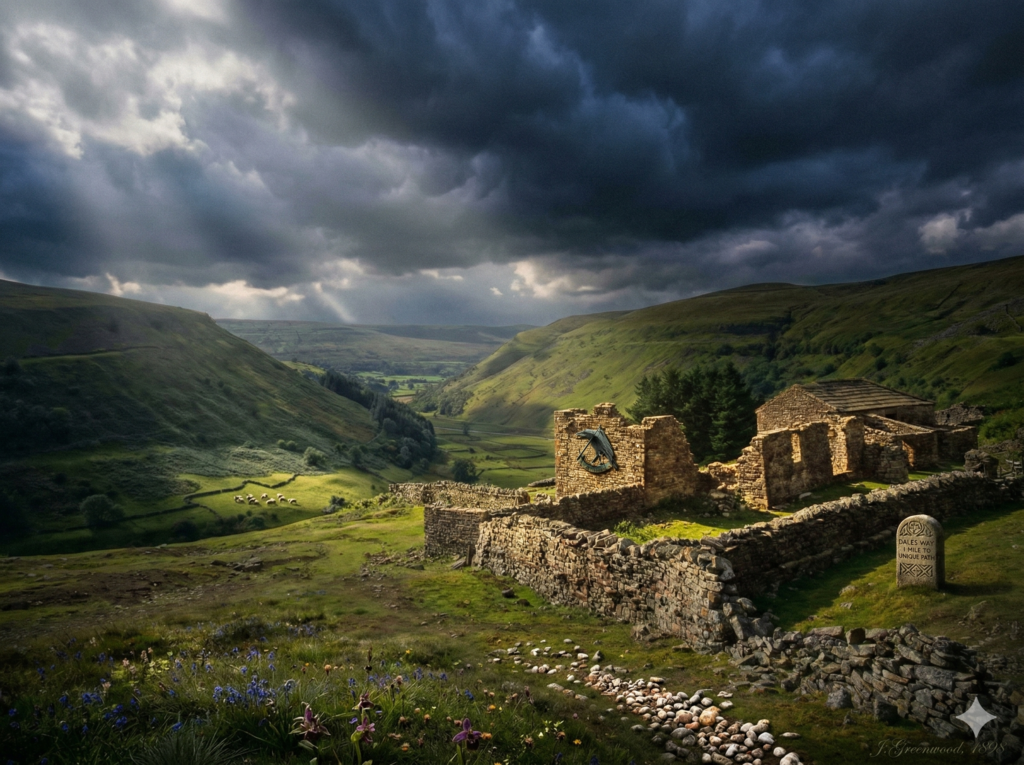
The Coast to Coast (C2C) walk is not just a trail; it is a ritual. It is one of the definitive long-distance experiences in the world, a 192-mile (309 km) crossing of Northern England that has become a rite of passage for thousands.
But why do we still seek the hardship of a two-week walk, and can a 20th-century creation truly be considered a pilgrimage?
The answer is yes. A pilgrimage is defined by its intent.
While the C2C does not follow a saint’s path to a single holy relic, it offers the modern seeker a ‘thin place’—the Celtic concept where the gap between the physical world and the spiritual seems smallest.
By trading the digital chaos for the rhythmic, primal act of walking, we find clarity. We don’t walk to a destination; we walk to return to ourselves.
Here is your complete guide to this extraordinary journey, from its quirky history to its transformative power.
Part 1: The Legend of the Pebble
The C2C has a single, definitive creator: Alfred Wainwright (A.W.).
A legendary fellwalker and author, A.W. spent years meticulously mapping the Lake District.
In 1973, he published A Coast to Coast Walk, a guidebook designed not to dictate a rigid route, but to offer ‘a continuous line of walk’ between two seas.
Wainwright’s true genius was not just in finding the optimal paths, but in creating a physical ritual that mimics ancient pilgrimage:
1. The Pebble of Intent: Every C2C walker is meant to select a small pebble from the Irish Sea at St Bees at the very beginning of their journey.
2. The Commitment: This pebble is then carried, like a physical manifestation of a worry, prayer, or goal, for 192 miles across three National Parks.
3. The Absolution: At the end, in the tiny bay of Robin Hood’s Bay, the walker hurls the pebble into the North Sea. It is a powerful, tactile closing of a circle—a symbol of letting go and completing a transformative cycle.
This simple act, combined with the physical isolation, has elevated the C2C from a linear hike to a modern pilgrimage of the self.
Part 2: The Harvest of the Road
The benefits of this walk are rarely found in the physical challenge, but in the spaces between.
1. A Meditation in Motion: By the third day, your mind begins to quiet. The concerns of the office and home are replaced by a simple, primal focus: What is the path? Where is the next water stop? Where is the next hostel? This structure forces a deep, non-judgemental stillness that can last for hours.
2. Radical Disconnection: In many parts of the C2C (especially the Lake District and North York Moors), mobile signal is nonexistent. You are forced into a temporary ‘media fast.’ This creates a profound sense of presence and vulnerability that allows for authentic connection—to the landscape, to fellow travelers, and to yourself.
3. Community and Shared Purpose: A strange solidarity forms among ‘pilgrims.’ When you arrive, soaked and exhausted, at a remote bunkhouse, and meet other walkers who have faced the same moor, you share an immediate bond. These shared conversations, stripped of social hierarchies, are a cornerstone of the experience.
Part 3: Mapping the Kingdom: The Route and Sights
The C2C is traditionally walked West to East to keep the prevailing wind at your back. It is a journey of three acts, each with its own distinct character and “pilgrim” landmarks.
- Total Distance: ~192 miles (309 km)
- Total Duration: 12–15 days (average)
- The Ritual: Dipping your boots in the Irish Sea at St Bees and the North Sea at Robin Hood’s Bay.
Section A: The Lake District (St Bees to Shap)
This is the most strenuous, awe-inspiring part of the journey. You will pass jagged fells, slate-grey lakes, and historical sites of contemplation.
- SIGHT: St Bees Priory (Day 1): Built on the site of a 7th-century nunnery, this 12th-century Benedictine Priory is your spiritual send-off.
- SIGHT: Ennerdale Water and Black Sail Hut (Day 3/4): The remote Ennerdale valley feels ancient. Black Sail, a tiny former shepherd’s bothy, is one of the loneliest and most famous YHA hostels in the UK—a must-stay pilgrim rest.
- SIGHT: Shap Abbey (Day 6): As you leave the Lakes, you pass the poignant ruins of this 12th-century monastery, a critical rest-stop for centuries of travelers on the ancient ‘Corpse Road’ (the burial route to Kendal).
Section B: The Yorkshire Dales (Shap to Richmond)
A softer landscape of rolling green limestone dales, distinctive dry stone walls, and vast, silent moorlands.
- SIGHT: The Pennine Watershed (Day 7): A powerful geographical moment. You stand on the high, wild edge where the rivers begin to flow East toward the North Sea rather than West. You have officially crossed the backbone of England.
- SIGHT: The Tan Hill Inn (Day 9): The highest pub in Britain (1,732 ft). A warm, isolated sanctuary on a notoriously bleak and exposed moor. If Tan Hill is full, the next stop is often Keld, a classic Dales ‘pilgrim’ village.
- SIGHT: Richmond Castle (Day 11): Arrival in the market town of Richmond. Its massive Norman castle is a dramatic marker of progress. The town provides a chance to resupply and reconnect with society.
Section C: The North York Moors (Richmond to Robin Hood’s Bay)
A land of intense, purple-heather moors, ancient trackways, and dramatic, exposed ridges, leading finally to the sea.
- SIGHT: The Cleveland Tontine and Cod Beck Reservoir (Day 13): Walking the northern edge of the moors provides vast, panoramic views, with the Cleveland Hills to your left and the vast, flat plain to your right.
- SIGHT: The Lion Inn, Blakey Ridge (Day 14): A legendary remote inn standing alone since 1553 on a exposed ridge, another famous high-altitude beacon for travelers.
- SIGHT: Falling Foss Waterfall (Day 15/16): A beautiful, secluded tea garden and waterfall just before your final descent to the coast.
Practicalities: Navigation and Logistics
- The “Halfway” Break: Many walkers take a rest day in Richmond to recover before the final push across the North York Moors.
- Waymarking: Unlike National Trails (like the Pennine Way), the C2C is not consistently waymarked. You must be able to read an OS map, especially in the central section of the North York Moors where tracks can disappear into the heather.
- Transport: St Bees has a railway station on the Cumbrian Coast Line. Robin Hood’s Bay is served by buses to Scarborough or Whitby, where you can catch trains back toward the West.
Part 4: A Pilgrim’s ‘How-To’ Guide
This journey requires significant planning. Northern English weather is relentless and unpredictable.
1. Accommodation: Bunkhouses, Barns, and Inns
Booking in advance is crucial, especially in high season.
- Hostels and Bunkhouses: The core of the C2C community. YHA locations like Black Sail, Keld, and Robin Hood’s Bay are essential. Camping barns (like the Shepherd’s Bunkhouse in Patterdale) offer rustic, affordable rest.
- Traditional Inns: For comfort and camaraderie. Locations like The Bridge Hotel (Buttermere), Tan Hill Inn, or The Lion Inn are iconic stops.
- Camping: Wild camping is generally not permitted (especially in National Parks) without landowner permission. Use designated sites.
2. Gear: Travelling Light, Surviving Right
- Navigation: (Non-negotiable). OS Explorer Maps (5 or 6 maps cover the whole route) and a compass. A phone/GPS is a backup only.
- Footwear: Fully broken-in, sturdy mountain boots with excellent support and grip (Vibram is ideal for slippery limestone/slate).
- Waterproofs: High-quality jacket and trousers (not budget gear). You will get wet.
- Backpack: 30–40 Litres for a ‘hostel’ trip; 50–65 Litres if camping.
- Layering: Merino wool base layers (2 sets); insulating mid-layer (fleece/light puffer); hiking trousers (quick-dry). NO COTTON.
- Survival: Headtorch, whistle, personal first aid/blister kit (Molycorp and Compeed).
3. Practicalities: Water and Time
- Water: You cannot always filter water from streams (especially in farming areas). Carry the capacity for 2 Litres, and plan your refills.
Will You Answer the Call?
The C2C is not a holiday. It is a work of physical and mental endurance. It demands that you accept the mud, the mist, and the monotony of the path.
But in that acceptance, something shifts.
As you hurl your pebble into the North Sea at Robin Hood’s Bay, having completed your circle, you are not just a hiker; you are part of a 50-year-old lineage of seekers who chose to cross a kingdom on foot.
You return not just with photographs, but with a new perspective, a quieter mind, and a bone-deep understanding that sometimes, the longest way round is the shortest way home.
The path is waiting. The two seas are calling. Will you take the first step?
Leave a Reply