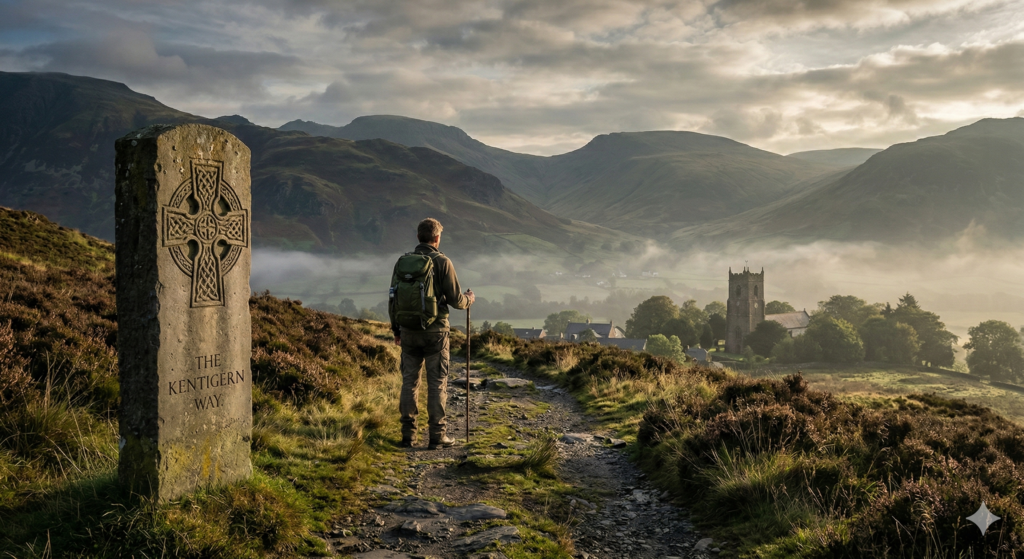
Cumbria, a land where jagged fells rise dramatically from ancient seas, holds many secrets.
While millions flock here for a weekend of hiking or boat trips, few truly encounter the landscape. There is, however, a way to move through these mountains that transforms them from a backdrop into a living companion.
This is the path of the pilgrim, and there is no better guide for this journey than St. Kentigern.
The Kentigern Way is not just a walk; it is an invitation. This 90-mile trail isn’t designed to challenge your peak-bagging endurance (though it is no easy stroll).
It is designed to immerse you in a deep, historical, and spiritual silence—the same silence that gave strength to one of the Celtic church’s most enigmatic saints 1,500 years ago.
The Legend of the Exile: Why We Walk
To understand the Kentigern Way, you must understand the man.
St. Kentigern (518–603 AD), often affectionately called Mungo (‘dear friend’), is famous today as the patron saint of Glasgow. His early life, however, was marked by exile.
When political upheaval forced him from his ministry in Scotland, Kentigern fled south to Cumbria.
This rugged territory, then a frontier between warring Celtic kingdoms, was where he spent 13 years living, preaching, and establishing churches in remote valleys.
The standard story tells that while exiled, Kentigern stayed for a time with his disciples at Crosthwaite (Keswick) and preached.
His journey eventually led him to Wales, where he founded the monastery of Llanelwy, before later returning to Glasgow.
The Kentigern Way, carefully mapped and dedicated by local enthusiasts, follows this legendary presence across Cumbria.
It is a pilgrimage in the footsteps of an exile—a man who found peace and purpose when he was furthest from home.
A Journey for the Soul: The Personal Benefits of the Trail
The true destination of any pilgrimage is within. What can you expect to gain from walking the Kentigern Way?
1. Silence and Stillness: In a world of constant noise and demands, the northern Cumbrian valleys—particularly around Caldbeck and Crosthwaite—offer a profound quiet. The slow pace of 90 miles forces you to disconnect, allowing your mind to still and thoughts to surface that are usually drowned out.
2. Physical and Mental Renewal: This is a physical commitment. It builds strength, but it also cleanses. The routine of walking, resting, and eating is simple and profound. Many pilgrims find a strange mental clarity emerge by the second or third day, a feeling of the mind ‘unpacking’ itself.
3. Connection to Heritage: You will touch stones laid by medieval monks and stand where 6th-century preachers spoke. The 12 ancient churches dedicated to St. Kentigern are not just museums; they are active sanctuaries that offer moments of historical awe and modern sanctuary.
4. A New Community: The “Pilgrim Passport” (which can be obtained locally) provides a connection. When you see someone else with one, you share an immediate bond. Hostels and local pubs are filled with stories of the trail.
Mapping the Way: Route, Timescale, and Mileage
The Kentigern Way is a linear journey, traditionally walked from South to North, connecting churches dedicated to the Saint. Here is a sample itinerary designed for a thoughtful, achievable pace.
The Total Commitment:
- Distance: Approximately 90 miles (145 km)
- Total Duration: 7–9 Days (at a recommended pace of 10–13 miles/day)
| Stage | From | To | Distance (Approx.) | Highlights |
| Day 1 | St. Kentigern’s, Crosthwaite (Keswick) | Threlkeld | 10 Miles (16 km) | The stunning departure under the shadow of Skiddaw; ancient stones and quiet fields. |
| Day 2 | Threlkeld | Mungrisdale | 11 Miles (17.5 km) | Winding paths below the dramatic peak of Blencathra. A true fell-side day. |
| Day 3 | Mungrisdale | Caldbeck | 13 Miles (21 km) | Traversing the “Back o’ Skiddaw.” Deep, wild solitude and the delightful arrival into Caldbeck (where Kentigern preached). |
| Day 4 | Caldbeck | Ireby | 9 Miles (14.5 km) | A gentle crossing into a hidden, peaceful valley. |
| Day 5 | Ireby | Brigham | 13 Miles (21 km) | A transition day, moving from high fells to softer, rolling Cumbrian farmland. |
| Day 6 | Brigham | Crosscanonby (via Dearham) | 12 Miles (19.5 km) | Reaching the coast. This is a day of deep history, visiting two highly significant Kentigern sites and reaching the Irish Sea. |
| Day 7 | Crosscanonby | Aspatria | 10 Miles (16 km) | Walking inland to Aspatria (meaning ‘the ash of St Patrick’), a major historical church. |
| Day 8 | Aspatria | Bromfield | 7 Miles (11 km) | A shorter, reflective day through quiet Cumbrian lanes to a perfect, isolated church. |
| Day 9 | Bromfield | St. Kentigern’s, Mungo (Silloth) | 5 Miles (8 km) | A final walk across low-lying marshes (watch the tide!) to the final destination on the Solway Firth. |
Finding Sanctuary: Where to Stay
Accommodation options are varied. Some days offer more choice than others. Booking is essential, especially in peak season.
1. Pilgrim Hostels and Refuges: This is the ideal. Some churches offer simple ‘pilgrim accommodation’ or have local links to affordable hostels. The Keswick and Threlkeld areas have excellent hostel options (like YHA Keswick or the Threlkeld Village Hall bunkhouse).
2. Local B&Bs and Inns: This will be your most common accommodation. Villages like Caldbeck and Mungrisdale have charming, traditional pubs (like the Oddfellows Arms or the Mill Inn) that have welcomed travellers for centuries. These are perfect for warmth and community.
3. Camping: For the minimalist. Be aware that wild camping in Cumbria is often illegal without landowner permission. Designated campsites are available near major points like Keswick and Threlkeld.
The Pilgrim’s Pack: How to Prepare
Pilgrimage is about traveling light, but traveling smart. This is Cumbria: you must be prepared for everything.
Essential Equipment:
- The Guidebook: Essential for the specific route navigation (there is a primary Kentigern Way guidebook).
- OS Map & Compass/GPS: Even with a guide, a map (OS Landranger or Explorer) is non-negotiable for safety.
- The Pilgrim Passport: (Often available via the guidebook or at the start church) – get stamps at the churches you visit. It makes the journey tangible.
- Footwear: Broken-in hiking boots. Do not start this walk in new shoes. A blister can end your pilgrimage.
- Waterproofs: High-quality jacket and trousers. Cumbria is beautiful because it rains.
- Backpack: 30–40 Litres is plenty if you are hosteling; 50+ Litres if camping.
The “How To” Guide:
- Training: Spend 4 weeks building up your mileage. By week 3, you should be able to comfortable walk 10–12 miles for 2 consecutive days.
- Tides: The final two days (Bromfield to Silloth) cross low-lying land near the Solway Firth. Check the tide tables. Local advice is that some sections are only passable for 4 hours either side of low tide. Do not attempt crossings when the tide is coming in.
- Start and Finish: Both are accessible. Keswick has good bus links to Penrith (mainline trains). Silloth is a smaller coastal town with bus connections back to major points.
A Walk in Silence, A Return to Self
The Kentigern Way is not a holiday. It is a work of physical and mental dedication. It demands that you slow down. It demands that you look up.
As you stand by the tranquil waters of Bassenthwaite, or look up at the red sandstone tower of Aspatria, you are not just a hiker; you are part of a 1,500-year continuity of searching.
You follow a saint who was forced from his home, only to discover a deeper mission and an unshakable inner strength in these very fells.
This is your invitation to find your own strength, your own clarity, and your own connection.
The ancient bells of St. Kentigern are calling. Are you ready to answer?
Leave a Reply